A Threshold Witch Approach to Knowledge and Conversation of the Holy Guardian Angel
At the Threshold of the Angel

There is an operation that has haunted the Western magical tradition for six centuries.
It appears in manuscripts passed hand to hand through Jewish mystical circles in fourteenth-century Germany. It surfaces again in the Elizabethan court of John Dee, reframed as angelic communication conducted through a scryer and a shewstone. It runs as a subterranean current through the Golden Dawn’s grade system, breaks the surface entirely in Crowley’s Liber VIII and The Book of the Law, and echoes forward through the chaos magic of the 1980s and into the contemporary revival of practical occultism that surrounds us now.
The operation is called Knowledge and Conversation of the Holy Guardian Angel.
The name is old. The ambition behind it is older still.
And if you understand what this operation is actually asking of you — not what the grimoires say it is, but what it does — then you understand the central task of any serious magical life.
But just incase you don’t know, I am going to tell you exactly what that is.
The Historical Record
The primary source for this operation as most magicians know it is The Book of the Sacred Magic of Abramelin the Mage, a text surviving in a fifteenth-century French manuscript and later translated into English by S.L. MacGregor Mathers in 1897. The manuscript purports to be the written account of Abraham of Worms, a German-Jewish Kabbalist, who received a system of magical instruction from an Egyptian magus named Abramelin. The central operation described requires the magician to withdraw from ordinary life for a period of six months — eighteen months in the longer German versions of the text — undertaking a program of prayer, purification, abstention, and increasingly intensive ritual in order to achieve direct contact with the practitioner’s own Holy Guardian Angel.
The Angel, once contacted, was understood to grant access to a system of magical squares and demonic servitors. But the attainment of the Angel itself was treated as the indispensable prerequisite. Everything else followed from that relationship.
Crowley encountered this work early and recognized something in it that the Victorian occult establishment had largely failed to see. Writing in Magick in Theory and Practice (1913), he declared:
“The Single Supreme Ritual is the attainment of the Knowledge and Conversation of the Holy Guardian Angel.”
For Crowley, this was not one operation among many. It was the operation — the axis around which the entire system of Thelema rotated. His own account of achieving it, recorded in the Equinox and revisited throughout his diaries, describes a process of destabilization followed by integration: an encounter with something that was recognizably himself and yet not the self he had believed himself to be.
But the roots go deeper than Abramelin.
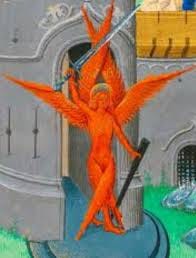
The underlying concept is present in the Neoplatonic conception of the daimon — the intermediary spirit that Plato describes in the Symposium as occupying the space between the human and the divine. In the Phaedo, Socrates speaks of a guiding spirit assigned to each soul, one that remains with the individual through life and conducts the soul after death. This is not an external protector in the popular sense. It is something closer to an organizing principle — the deep form that a human life takes when it is fully itself.
The Roman tradition preserved this concept in the genius — not intelligence in the modern sense, but the animating spirit of a person’s essential nature. The genius was understood to be the fullest expression of what a man was capable of becoming. To honor one’s genius was to align oneself with one’s own deepest pattern.
Later, the Hermetic tradition, particularly through texts like the Corpus Hermeticum and the Asclepius, developed the idea of the Agathos Daimon — the Good Spirit — as a divine intelligence that accompanied and guided the serious practitioner. The Egyptian magical papyri, particularly the Greek Magical Papyri (PGM), include extensive invocations to this figure, some dating to the second and third centuries CE.
What we call the Holy Guardian Angel, then, is a concept with roots not in medieval angelology but in the deepest structure of Western occult philosophy.
